Available for St Albans District residents to borrow during the winter months FREE. To book your place on an Information sessions and then borrow the camera see Events pages. Please also see our Thermal Imaging Camera Guides.
Please sign up to our newsletter to be the first to hear of new sessions.
Why borrow a thermal imaging camera?
A thermal imaging camera enables you to see heat leaking or cold air entering your house by taking colour-coded images highlighting temperature differences.
The camera can highlight insufficient loft insulation, gaps in floorboards, draughty windows, badly fitted loft hatches, and much more. These areas allow warmth to escape, meaning you use more fuel to keep your house warm. See our case studies for more information and ideas of how they have been used in local buildings along with advice on what to do next, and also our blog page for blog articles relating to using the thermal imaging cameras in homes, schools and community buildings and reducing heat loss at home.
How the information sessions work?
We run regular 40 minute information sessions – between October and March/April each year. See Events pages for the upcoming dates and to book your place. The cameras are available for residents of the St Albans District to borrow the camera, it is free to borrow a camera although donations towards the running costs for the camera project are always welcome! The camera is not generally available to those living outside the district. A £200 security deposit cheque (or electronic payment) is required. The deposit cheque is destroyed (or payments refunded) once the camera is returned in working order.
The Information sessions look at: a) what you can learn about your home by using the camera, b) the arrangements for booking to borrow the camera, and for the collection and return of the camera, c) the handling of security deposits, followed by time for questions and answers.
Please note the sessions are frequently fully booked, if you can no longer attend, please cancel by EventBrite or advise us ASAP so that someone else can have that place. Before you attend the information session it is helpful if you read the information pack.
Sustainable St Albans has three (different) thermal imaging camera (known as “Harpenden Camera”, “St Albans camera” and “Community Camera”). The “Harpenden Camera” and the “St Albans Camera” are loaned to St Albans district residents on a daily basis and the “Community Camera” is loaned to schools and to community groups on a weekly basis. Following the information session you will be sent links to various Eventbrite Borrowing Events to book to borrow the camera. The cameras are held by our thermal imaging camera volunteers on rotation; current locations include (eg Central Harpenden, West Harpenden, Redbourn, AL1 South East, AL1 Bernards Heath, AL4 Colney Heath Lane, London Colney).
We also have a SSA Thermal Imaging Project facebook page where camera users can share their experiences and findings.
Using the thermal imaging cameras?
The information pack provides information on how to use the cameras and what the cameras can show you. Additionally there are videos on using the cameras and the manufacturers’ Manuals can also be viewed below.
- Information Pack – this is a short User Guide, written by our volunteers, which covers using the camera, what the camera can show you, the terms and conditions for borrowing the camera, deposit arrangements and procedures for collection and returning the camera. Information session presentation.
- Videos on using the cameras: Harpenden camera, St Albans camera, St Albans camera additional video on setting suitable temperature ranges, Community Camera ; (to see subtitles, switch on captioning before playing);
- Manufacturers’ Manuals: Harpenden camera, St Albans camera, Community camera
After you have borrowed the camera? Borrowing it again?
Over 1000 people have borrowed one of our cameras over the last 10 years! If you have borrowed a camera and want to do so again to see the impact of changes you have made, get in touch using the form below. It will help our volunteers if you can include details of when you attended an Information Session.
- It will also help us and future borrowers if you complete our short survey.
- Sharing experiences with other camera borrowers – we have a SSA Thermal Imaging Project facebook page where camera users can ask questions and share their experiences and findings.
- You are also welcome to borrow the camera again – please complete the


What do you find out using the camera?
What can I do about a cold hallway?
A vintage front door with single glazed glass panels is shown to be register cooler sections. Fitting a thermal portia curtain shows a much warmer and consistent impact on the temperature inside: the images show a door before and after a thermal portia door curtain had been fitted.


My radiators don’t seem to be keeping my house warm
Not sure that your radiators are heating up your home as much as they should do, or as much as they used too?

Use the camera to check whether your radiator is heating the outside wall.
This image taken from outside shows heat escaping through the house wall (no cavity wall) from a radiator (left hand side of image below the window). Note the camera was set to a different colour scheme for this image.
Reduce heat loss by putting foil behind your radiators to reflect the heat back into your home; radiator foil is available from DIY stores though kitchen foil does a good job too!

Are your radiators working properly?
You can use the camera to detect radiators that have partially silted up and need flushing out. In this image the dark area of the image is where the water is not circulating in the radiator.
Are you heating the roof or the outside?
Maybe heat is escaping through your roof? The camera can show you whether your loft hatch is insulated and you can see loft areas with inadequate insulation, to be investigated.

Check insulation
The dark areas of the image show areas with no insulation that could be investigated.

Check your loft-hatch
Have loft insulation but there are still draughts? Check to see if your loft-hatch has been insulated. You can also try to prevent those small drafts around you loft-hatch by using draught proofing tape. This image shows the effect of an un-insulated loft hatch compared with the surrounding insulated roof.
Stop heat going up the chimney
Put a chimney balloon up any chimney that is not being used. Remember to take them out again should you decide to use your chimney!
Draughts coming up between your floorboards?
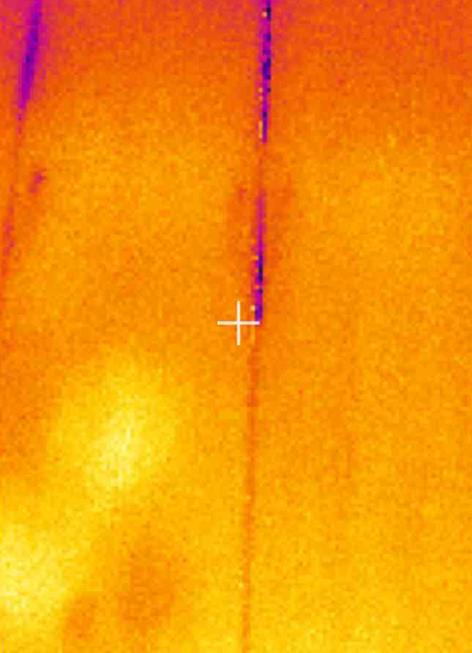
Keeping draughts at bay
If you have wooden floorboards (particularly those in older houses that are laid directly on beams), you can reduce heat loss by filling the gaps between and around them with an acrylic sealant or with tubing that you can put between the gaps.
Image showing where Gap sealer had been fitted in the lower part of the image but not the upper part.
Timber floors can also be insulated by lifting the floorboards and laying mineral wool insulation supported by netting between the joists. Gaps between floor boards and skirting boards are also an area where heat can be lost; DIY stores have a variety of options for filling gaps. Using rugs or carpet also helps to reduce heat loss.
Quick, low cost ways to reduce your energy consumption include:
- Closing the doors of rooms you don’t use.
- Closing curtains and blinds at dusk, even in rooms you’re not using. If you have long curtains over a radiator, tuck the curtains behind the radiator (so as not to heat the window) or, better still, shorten the curtains!
- Turning off devices, especially at night.
- Putting foil behind your radiators to reflect the heat back into the room.
- Ensuring you have a letter box that doesn’t allow heat to escape.
- Use your appliances less: for example doing full loads of washing/dishwashing; using a clothes line to dry clothes.
- Turning your heating down slightly and adjusting thermostats on your radiators.
.. methods that cost a little more or require a bit of DIY include:
- Fitting a door curtain.
- Flushing out radiators that aren’t working properly.
- Draught proofing your door by fitting draught seals.
- Prevent draughts through letter boxes by fitting a cover/brush and through keyholes by fitting a keyhole cover.
- If you have a catflap, you can fit insulation or a blanket flap.
- Insulating your loft hatch
- Lagging hot water tanks and water pipes.
.. and then there are the more significant ways to reduce your energy consumption
- When replacing appliances check the energy ratings before you buy.
- Upgrade your windows to double (ideally triple) glazing. Less costly options are to cover them in a clear plastic film (available at DIY shops) that tightens over the pane when heated with a hairdryer.
- Insulate your loft.
- Install or top up cavity wall insulation or install solid wall insulation.
- Install solar panels (check out Solar Streets).
- Install a heat pump (particularly if you already have underfloor heating).
Further resources
- Stay Warm for Less. A very readable booklet giving you lots of ideas step by step on what you can do to Stay Warm for Less
- Energy Savings Trust. Their website provides information about saving energy.
- Energy Saving Trust Insulation Guide
- Energy Savings Trust Draught Proofing Guide
- Centre for Sustainable Energy DIY Draught-Proofing Guide
- Centre for Sustainable Energy loft insulation
- Centre for Sustainable Energy cavity wall insulation
- Cambridge Carbon Footprint website has useful resources relating to thermal imaging cameras and also more generally about reducing energy use.
- Green our Herts website provides resources to help you make your home greener, as well as other information relating to reducing carbon use more generally.
- St Albans District Council website also has useful advice including information about grants and measures to improve energy efficiency.
- Check out the Great British Insulation Scheme here, and find out if you are eligible for free or cheaper insulation to reduce your home’s energy bills. You can also obtain additional information on the Money Saving Expert website.
- Simple information on this and other grants and payments and energy saving measures can be found on the government Simple Energy Advice website.
With thanks to our local Herts County Councillors
Sustainable St Albans has three thermal imaging cameras that residents can borrow. One camera is based in Harpenden, one in St Albans and the third one is made available to schools and community groups accross the district.
We are grateful to Herts County Councillors Teresa Heritage (Harpenden), Geoff Churchard (Sandridge), Robert Prowse (St Albans East) and Sandy Walkington (St Albans South) for grants in 2014 and 2015/16 to enable us to purchase our first two cameras.