Have you ever wondered how you could satisfy your wanderlust without a huge carbon footprint? Many people feel conflicted about travelling. On the one hand, it’s one of life’s pleasures — a way to get to know the world and different cultures. But mainstream travel is highly polluting, with flights contributing to carbon emissions and popular accommodation models such as Airbnb driving up local house prices and not always giving back to the economy.
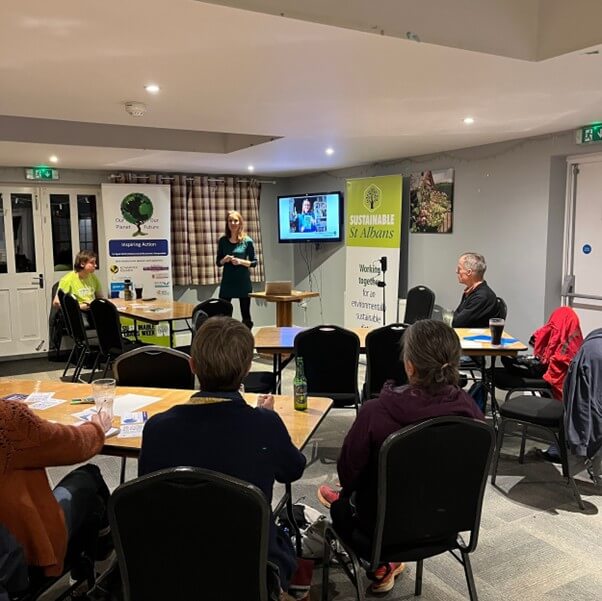
At our recent event ‘Satisfy Your Travel Bug Without Flying’, we were joined by Anna Hughes of Flight Free UK and James Blake of Youth Hostels Association who shared inspiring stories and creative inspiration for travelling with a minimal carbon impact.
Flight-free but flying high
Anna was first up, starting her talk with a captivating account of how she gave up flying 15 years ago and eventually set up Flight Free UK. Although she’d embraced sustainable living from a young age, it wasn’t until she watched The Age of Stupid that she really began to question her lifestyle. Centred around the question ‘why didn’t we save ourselves when we had the chance’, the film touched her to such an extent that she immediately cancelled tickets for an upcoming flight.
But her love for travel remained. Instead of resigning herself to a life of going nowhere, she set about reimagining her relationship with travel, embarking on a 4,000-mile cycling trip around the British coast. 10 weeks and just one puncture later, she ended her journey, having seen new landscapes, tasted interesting foods and heard many different accents and even languages. All without stepping foot on a plane.
Some shocking statistics
Anna shared some sobering statistics that put our travel choices into perspective. A flight from the UK to Bali emits roughly 3.37 tonnes per passenger. Compare this to the annual global average carbon footprint of 2-3 tonnes of carbon per year, and you can quickly see how those of us in the North often have carbon footprints of 9 tonnes per person or more. In contrast, modes of transport such as international electric rail, coaches and ferries (as a foot passenger) use much less carbon and are often cheaper.
In the UK, the most frequent destinations are France, Spain and Italy — destinations which are all easily reachable by train in a day or less. If you take a train from London to Barcelona, you’ll save 91% of the emissions you’d generate if you took a flight — and get to see the Mediterranean sea, the Pyrenees and flamingos from your train window.
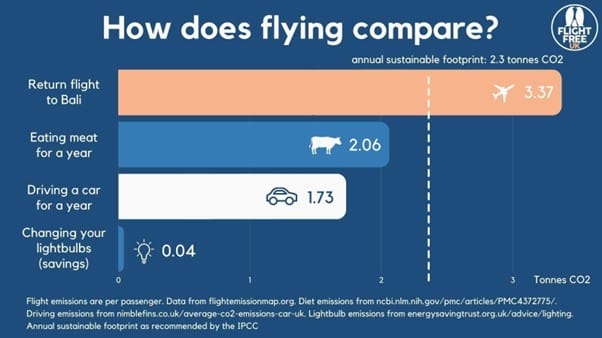
Anna said that we often hear about buying fewer clothes, changing our eating habits and using more efficient heating. But giving up flying is one of the most effective ways we can lower our carbon impact as individuals.
The Flight Free Pledge
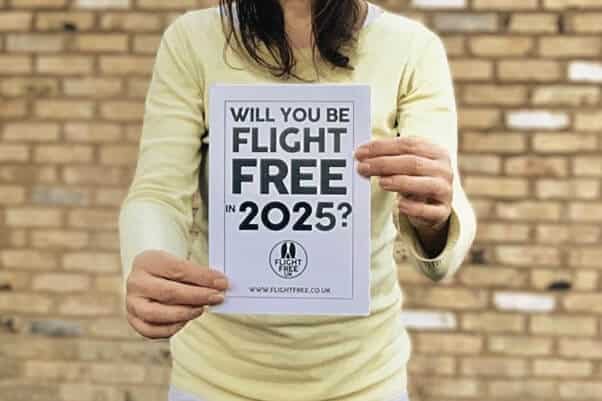
Flight Free UK challenges people to take the Flight Free Pledge to take a year off flying – something that feels more doable than giving up flying completely, although many do go on to complete rethink their relationship with flying.
You can customise the pledge so it works with your lifestyle. For example, you could pledge not to fly in Europe, pledge not to fly unless necessary (for your child’s wedding in another continent or an island hope to Shetland), or you could make the pledge to never fly again.
95 years of reconnecting with nature
While Anna illustrated how we can rethink long-distance travel, our second speaker, James Blake, Chief Executive of the Youth Hostels Association (YHA), shared an insight into how we can discover fulfilling adventures closer to home.
The YHA was set up during the Great Depression to help young people from industrialised cities reconnect with nature and is celebrating its 95th birthday this year. A milestone which hung in the balance when the pandemic halted all travel.

Medieval castles and private coves
James shared how YHA’s diverse range of accommodations — which includes Georgian homes, medieval castles, and a pirate’s cove — offer more than just a bed for the night. In the words of a primary school child, visitors can enjoy views of “national parks, not carparks.”
In this sociable space, young people are encouraged to explore, learn, and build lifelong confidence with new experiences. The YHA has introduced many initiatives to encourage more young people to nature, including the Festival of Walking, bursaries to allow children from low-income families to join school trips and breaks for young carers. And you don’t need to be ‘young’ to stay at a youth hostel – just young at heart.

The impact of a changing climate
The pandemic and climate change have both left a mark on the YHA’s ageing infrastructures — floods in Boscastle and Keswick severely affected hostels. Despite this, YHA has adapted by focusing on energy efficiency and tweaking its business model to include franchises to keep their vision going.
Every small choice — from opting for public transport and installing water refill stations to encouraging people to bring their own food and other items — contributes to making youth hostels a more sustainable option for travellers.

And, as both Anna and James demonstrated, a more sustainable approach to travel doesn’t need to be limiting — all you need is imagination. As more of us become concerned about protecting nature, we hope this will inspire your next trip.
You can see the slides from the event here and watch the presentation here.
Our next event
Why are chemical companies selling toxic products? What is regenerative agriculture and how could it help stabilise the climate? What’s the link between farming and biodiversity loss?
Join us at 7:30 pm on Tuesday the 13th of May for our next inspiring event. We’ll be watching Common Ground, the highly anticipated sequel to Kiss The Ground, which reveals the politics behind our broken food system. Book your free spot here.