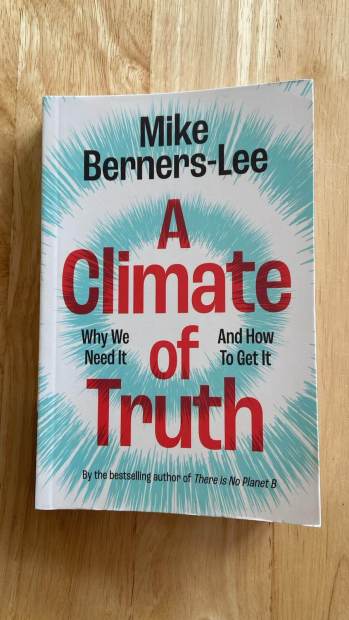
For our October read, Our Planet Our Future Book Club picked A Climate of Truth by Mike Berners-Lee. Arguing that we can only begin to solve the polycrisis – the combined climate, food security, biodiversity and pollution crises – once we demand truth at all levels, the book sparked a lively discussion and inspired us to think more about how we can take action ourselves.
An accessible read that doesn’t pull punches
A Climate of Truth is the kind of book you could give to a friend who knows little about climate change. Compared to some of our previous reads, Berners-Lee’s writing is clear and approachable, with plenty of examples to illustrate his points.
But he is also frankly honest and not afraid to pull punches, calling out politicians and businesses that have skewed the truth for their own ends at the expense of planet and people. We admired Berners-Lee’s honesty in calling out public figures while remaining balanced and factual; he urges us to respect others with wildly differing views in our pursuit of the truth. A noble, but not always easy, pursuit.
Berners-Lee presents the facts in his incontrovertible manner, demonstrating how the general public has been repeatedly mislead by politicians on topics such as Brexit, the pandemic and on climate change issues. The examples he gives are hard to deny and he shows how misinformation is often deliberate.
One reader described it as ‘a book that digs beneath the whole topic of climate change to examine how humanity is responding, and then beyond that to expose the values underlying our behaviour’.
Shocking insights
The book’s sobering – and counterintuitive – intro explains that, instead of decreasing carbon emissions, efficiency gains have had the opposite effect, encouraging an almost insatiable demand for more energy.
With carbon- and water-hungry AI gaining in popularity, this picture looks set to increase unless action is taken. As we discussed, some data centre operators are building their own nuclear power stations, while others are building them underwater to avoid overheating. We wondered what the author of a previous book club read Blue Machine, Helen Czerski, would have to say about that.
What we read informs our worldview, even if we’re simply clicking on an article shared on social media rather than consciously subscribing to a paper. Although it’s well known that many of the UK’s media outlets are owned by a small handful of millionaires, some of us were still shocked by the extent. Only a small number of newspapers, including The Guardian and The Financial Times, come out unscathed for their investigative journalism and willingness to correct errors.
Even respected organisations like the BBC often give airtime to extremist views in the interests of presenting ‘both sides’ of debates, when fact-checking would reveal bias and a misrepresentation of facts. One reader shared that she had written to them to ask them to get better at presenting the truth rather than just giving equal airtime to opposing views.
We can’t act on what we don’t know, and the media plays a huge role in which stories get told and capture the public imagination. Recent stories about a shipping reform being vetoed by a couple of countries was reported in the media as a sidenote, when it will have big repercussions.
Reasons to be hopeful
But not everything is doom and gloom. Churches and schools are now regularly measuring their carbon footprints, repair cafés and circular malls like Sweden’s ReTuna are becoming popular and businesses are tracking their supply chains’ carbon impact.. something that would have been unheard of a few years ago
Sensible legislation could make sustainable choices the norm for everyone. This has already been successful in the past, with mandatory switching to energy-saving lightbulbs. But could we go further? Banning new gas boilers and building new homes to Passivhaus standards would be a start, as would mandating grey water flushing systems. The book shows other people care more about the polycrisis than we assume, a fact backed up by experiments.
We thought an independent fact-checking organisation, similar to Full Fact, could be made mandatory for all AI-generated content and social media posts, to make the general public more aware of the full extent of misinformation.
How you can take action
In A Climate of Truth, Berners-Lee shares actionable tips on how you can demand more from politicians, businesses and the people around you. These are some of the tips we discussed:
- Engage your MP. Your MP can’t represent the things you really care about if you don’t tell them. Write to them about climate or environmental issues. Several of us have received personal letters back, suggesting it can make a difference.
- Switch your pension or banking. Or, if that’s not possible, ask your provider to divest from fossil fuels and invest in ethical funds. Check out the Friends of the Earth’s Money Movers initiative.
- Support independent journalism. Pay for trustworthy news sources that prioritise facts over clickbait. One member said the book encouraged her to finally pay for a Guardian subscription.
- Model sustainable habits. Nagging and preaching never inspire anyone. But if you can share a delicious homegrown dinner with a friend, show how insulating your home has saved you money, share surplus veggies with friends or show off a recent repair, you never know how this might ripple through your community. One of our readers shared how our recent flight-free travel OPOF event inspired him to hold off flying for a year.
- Vote for the greater good. Consider the long-term wellbeing of people and planet when it’s time to cast your ballot. Resist the temptation to vote for personal gain.
- Advocate at work. If your organisation contributes heavily to carbon emissions, research alternatives and speak up for change.
Our next event
Want to broaden your knowledge of sustainability challenges and solutions while meeting like-minded readers?
On the 4th December, we’ll be discussing our first cli-fi book, The High House by Jessie Greengrass, at the Cross Keys pub in Harpenden. Book your free spot here. The book is available on Hive, Audible, Hertfordshire Libraries and Borrow Box.
About Our Planet Our Future’s Environment Book Club
Our Planet Our Future, Sustainable St Albans’ landmark series of talks and events, launched the Environment Book Club in 2023. The book club meets monthly in Harpenden to explore books that inspire us to live more sustainably and think differently about the future. Join us and be part of the conversation.
Catch up on previous book club reviews
Explore our past discussions and discover more sustainability reads:
- Prosperity Without Growth by Tim Jackson
- Braiding Sweetgrass by Robin Wall Kimmerer
- Blue Machine by Helen Czerski
- Badvertising by Andrew Simms and Leo Murray
- Doughnut Economics by Kate Raworth
- Regenesis by George Monbiot
- Five Times Faster by Simon Sharpe