
When was the last time you travelled to the future? Time travel might sound impossible, but anyone can do it with a little imagination, as the attendees of Our Planet Our Future’s latest event found out on the 12th of January. Helping us bend the rules was Tony Elkington of Reimagine Everything, a consultancy that brings people and organisations together to reimagine food, energy and democracy for a more sustainable future.
The playful workshop invited the audience – which included many eco-conscious people – to step into the year 2030 and imagine what the world would be like to help us visualise the steps we might take to get there.
The initial exercise had us placing ourselves on a spectrum from optimistic and pessimistic. We discovered many of us feel a tension between being too small to make meaningful change and yet powerless to influence those who do, big corporations and governments.
What initially seemed to be a get-to-know-you exercise became the backbone of the evening. We introduced ourselves to members of our tables by sharing our passions, skills, causes we care about and places around St Albans that matter to us. From there, each group was tasked with writing a news article from the future focusing on a successful local initiative that had a positive impact on the community.
Here is what we came up with in just 30 minutes:
Happy, Healthy Herts
One group imagined a Hertfordshire-wide agreement not to drive on the third Saturday of every month, paired with a 20 mph speed limit. On these days, neighbours chatted and children played in the streets. What began as a one-day-a-month experiment nudged longer-term behaviour change, with the newspaper reporting a 10% reduction in car use and better physical and mental health.

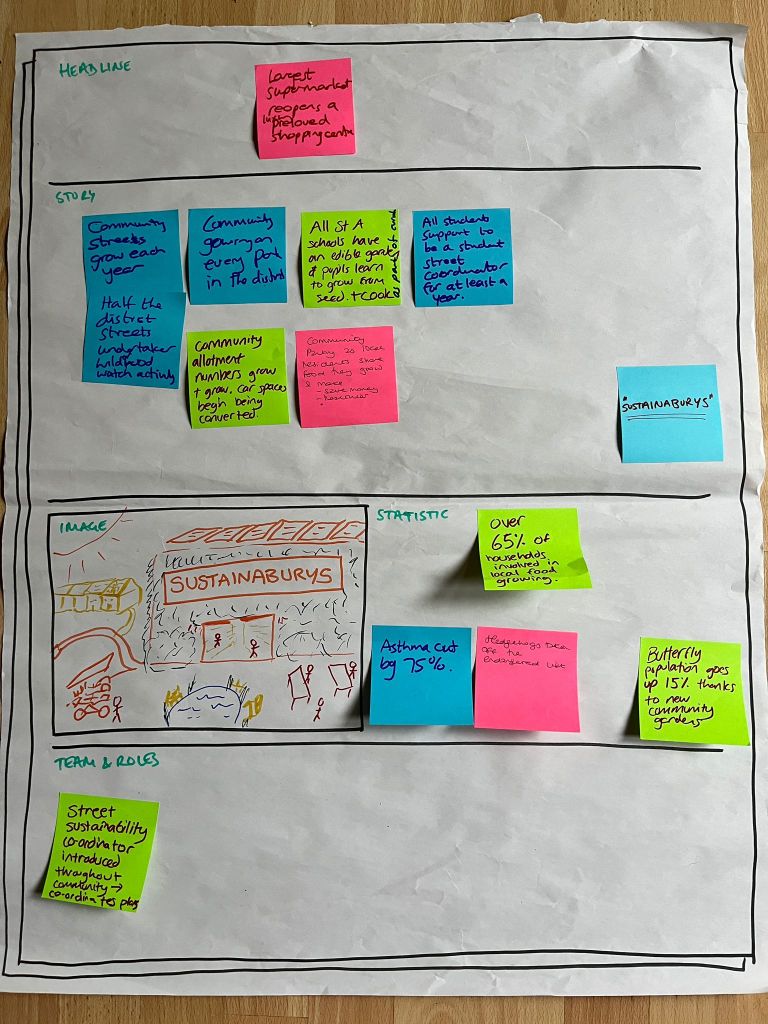
Sainsbury’s reopens as Sustainabury’s
Another group reported that the local Sainsbury’s branch had closed because of decreased demand when the local community started growing, sharing and repairing more. The space reopened as Sustainabury’s, a pre-loved shopping centre and repair hub similar to Sweden’s ReTuna. The initiative began gradually as streets came together to grow food on shared land and set up community pantries to redistribute surplus food. The initiative reached local schools, where GCSE-age students were assigned roles as sustainability coordinators on a street-by-street basis to help get projects off the ground.
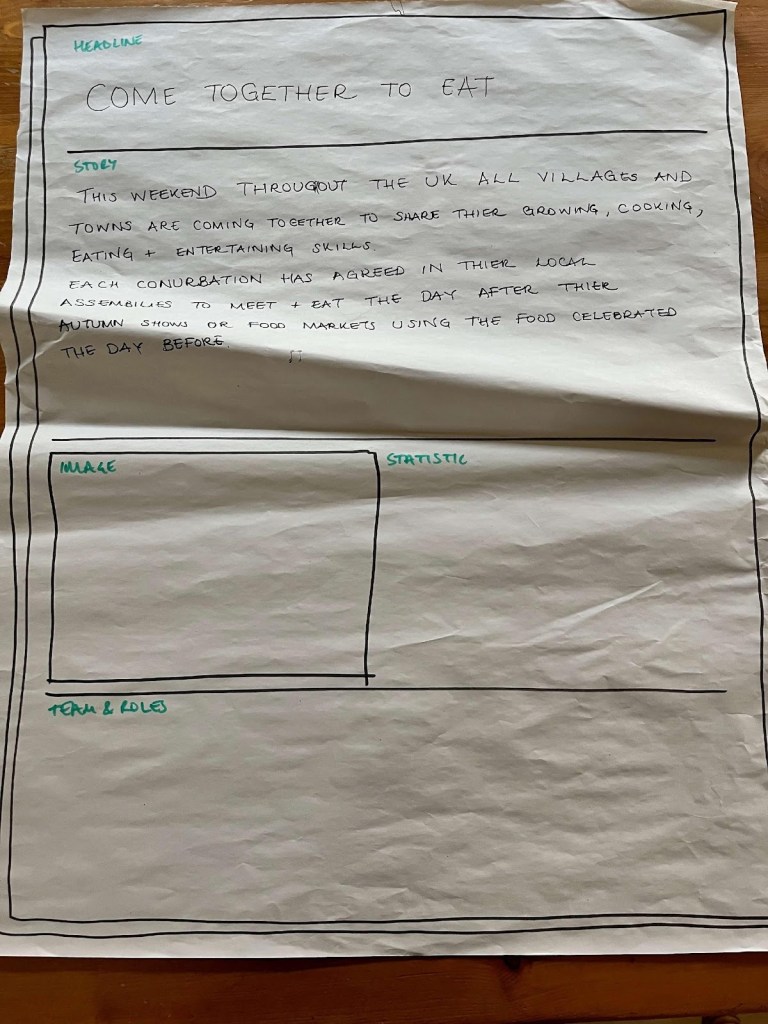
Come together to eat
Food was the focus for group three. All over the UK, residents came together to celebrate their shared growing, cooking and entertaining with an Autumn show or food market. The next day, all the food was consumed at a large local feast. Meals naturally became more plant-based without any need for explicit conversation because people were growing fruit and vegetables. This led to people valuing food more and reducing waste.
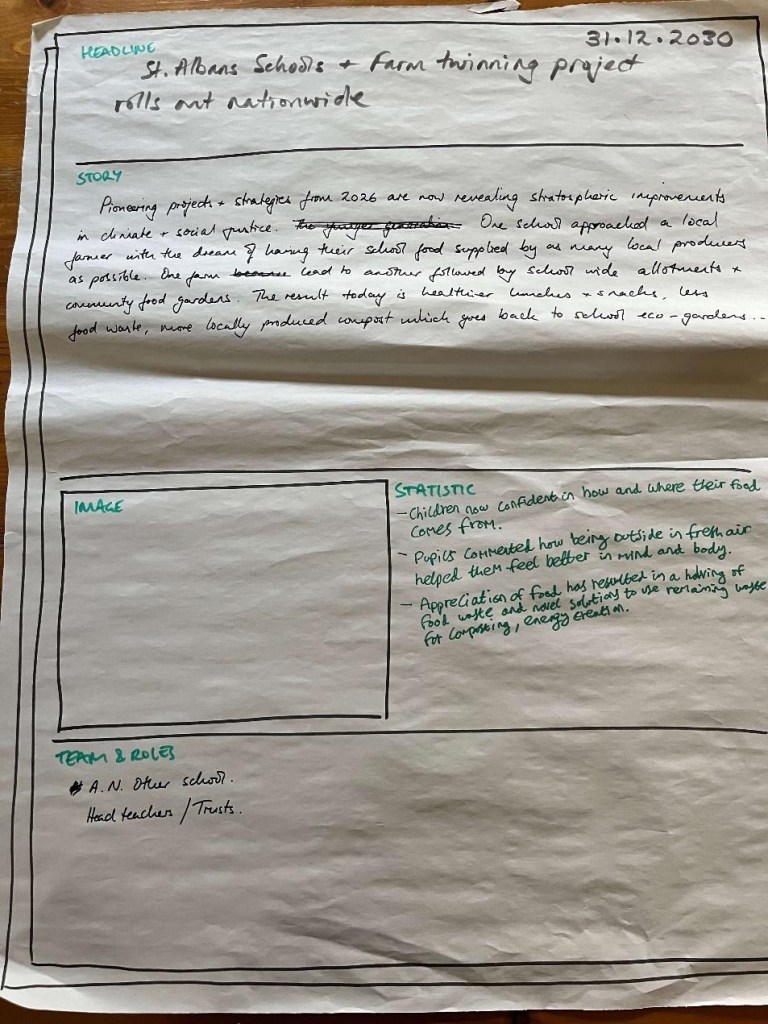
The school farm twinning project
The final group imagined a partnership between schools and local farms. Children regularly visited farms that also supplied school meals, learning exactly how their school dinner gets onto their plate. As a result, food waste halved, with scraps being composted or used for energy. The children now had a clear idea of where their food comes from and felt healthier and happier from being out in the fresh air.
The room was buzzing with ideas and aha! moments as each group shared their vision for the future. Tony said, ‘I expected this kind of experience to be most valuable for people who need nudging from concern into action, but I think it may actually be more important for people who’ve lost hope. It’s not blind optimism – it’s a reminder that the future is not fixed, and that the stories we tell ourselves about the future have real power over the future we bring into being.’
How you can get involved
Inspired by the presentations, we talked about how we could turn our various ideas into reality:
- Have that conversation. We often shy away from climate conversations because they can feel uncomfortable. But if you concentrate on small group actions, you don’t know who you’ll inspire. Your neighbours might be more interested in setting up a hedgehog highway or swapping tomatoes for courgettes than you imagined!
- Think small. What’s the smallest micro step you can take? Perhaps you could make it easier for residents to share food or close the street for a few hours. Over time small things build up and become bigger.
- Plan for the short-term. A five-year project feels more doable than a large one and you will quickly see results.
- When speaking to the younger generation be as concrete as possible about what action they can take. Children are often taught about the problems without the solutions, which can make them feel powerless.
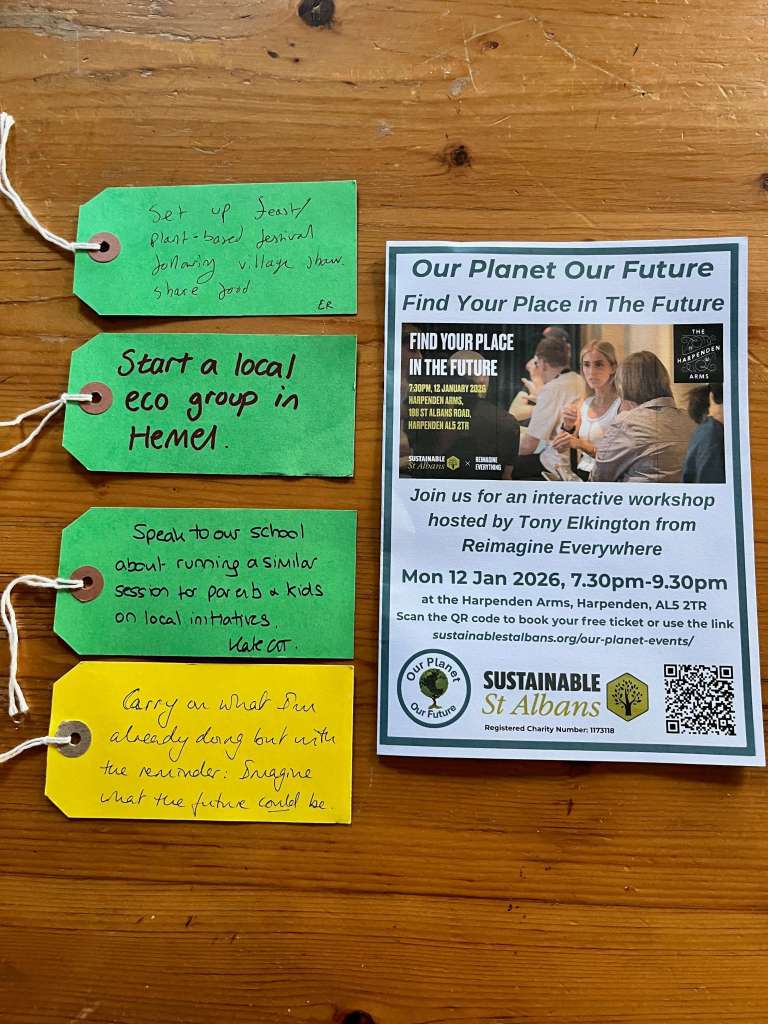
As with all events, participants were invited to write down pledges for the Promise Tree. These are small, tangible actions they felt inspired to take after the event. By committing a promise to paper, they become more powerful.
Now it’s your turn
Inspired to try a bit of time travel for yourself? Why not recreate this exercise at home with some friends and family. You could try it on your own, but often the best ideas are co-created by bouncing ideas off each other.
- Grab a piece of paper and answer the following questions:
- What brings you joy?
- What are you good at?
- What cause are you passionate about?
- Name a place that’s important to you.
- Share the answers with your friends – you might discover something you didn’t know.
- Grab a larger piece of paper and divide it into four sections for each question. Start pooling everyone’s answers to see if you can make any connections between them or if they complement each other.
- Brainstorm ideas that bring as many of your answers together as possible.
- Think about the tangible results, as these are what will give you motivation if the project gets tricky.
- Assign roles to each of the team members, or think about what support you might need.
Would you like to run a similar session with your group, organisation or business? Feel free to contact Tony directly at tony@reimagineeverything.co.

Dates for your diary
Our next event is Celebrating our Local Chalk Rivers at 7:30 pm on Monday the 9th of March at the Harpenden Arms, just ahead of the International Day of Action for Rivers on the 14th of March. We’ll be joined by Herts & Middlesex Wildlife Trust and other local groups to share what they’re doing and how you can get involved in developing your local chalk streams. Book your free ticket here.
And for the book lovers among you, our next book club event is a discussion of Katharine Hayhoe’s Saving Us: A Climate Scientist’s Case for Hope and Healing in a Divided World.