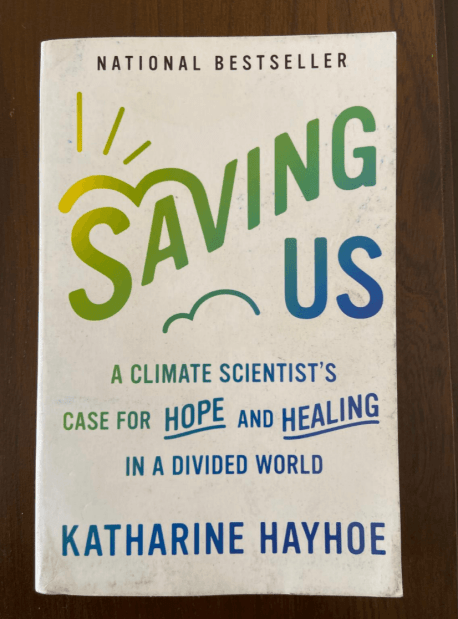
To kick off a new year of climate reading, Our Planet Our Future’s Sustainability Book Club read Saving Us by climate scientist and evangelical Christian Katharine Hayhoe in January. At first glance, Hayhoe’s religious and scientific identities might appear to be in tension. But, as she demonstrates in the book, it’s possible to hold faith and subscribe to climate science at the same time.
Originally from Canada and now based in Texas, Hayhoe spends much of her time travelling across the US speaking to groups about climate change, including audiences who hold very different views from her own. She is also the host of the podcast Talking Climate, writes a popular newsletter and gave a popular Ted Talk on the subject. As such, she is an exceptional communicator, and this clearly written, accessible book didn’t disappoint.
Hayhoe’s central message is that we need to be having more climate conversations with the people around us. If you’ve ever felt like you’re banging your head against a brick wall while attempting to chat to friends, family and colleagues, then this book is for you.
What surprised us most
We began our meetup by sharing what surprised us most. On a technical note, one reader was intrigued by Hayhoe’s reference to e-fuels, a method of combining carbon dioxide and hydrogen oxide to create a liquid fuel. When burned, the CO₂ that is released was previously captured, making them close to carbon neutral.
Solar geoengineering is another interesting technology that might help us in the fight against climate change. This process involves injecting reflective particles such as sulphate aerosols into the stratosphere to reflect sunlight away from the planet.
On to Hayhoe’s techniques, one reader was impressed by just how effective conversations can be, as demonstrated in the anecdotes throughout the book. For example, when arriving to give one talk, she noticed the group’s core values displayed prominently in their space, prompting her to throw out her original script and rewrite it so it was tailored to what they cared about most. She regularly uses empathy to win over people who profess to be uninterested in climate change. After, her audience will often tell her how what she has said makes sense, ‘not like those hippies always banging on about climate change.’
Far from wishing fossil fuels had always stayed in the ground, Hayhoe makes an interesting point: if it weren’t for coal and gas, human civilisation would never have developed the way it has. For that, she’s grateful. But now it’s time to move beyond them.
Gesture politics or infectious behaviour?
As a writer based in the US, can Hayhoe’s message be applied to the UK? One reader felt it was less relevant to our country. He was concerned it amounted to ‘gesture politics’ after 50 years of slow progress. This sparked a lively discussion, with other readers asking what the alternative to conversations would be.
On the other hand, visible change can be infectious. One member had recently installed solar panels despite living in a conservation area. His neighbours were curious about them: Who did it? How much did it cost? Was it worth it? Another member, who was considering solar panels, described how a neighbour had suggested they might not be aesthetically pleasing. This situation was also discussed in the book to highlight how visibility can show others what’s possible. Other ideas included installing EV charging points and sharing them with neighbours.
Greenwashing and fossil fuels
It can be tricky for non-climate scientists to assess which behaviours are more sustainable than others. For example, is replacing plastic with paper always better? Not necessarily. If not managed properly, cutting down trees can increase flood risk and reduce biodiversity.
Carbon credit and tree-planting schemes often double-count carbon savings or let tree plantations wither away. Could there be an alternative? Climatologist Professor Myles Allen has argued that fossil fuel companies should be responsible for cleaning them up.
Want more successful climate conversations?
Here are some actionable takeaways from Saving Us:
- Talk to people about what they care about. One member shared a story about chatting to a diver who initially dismissed her climate concerns. But as they spoke, it became clear he was passionate about how plastic pollution was damaging something he deeply cared about.
- You’ll be more successful if you start conversations with people who share your interests. Fishermen are best placed to talk to other fishermen. Knitters to knitters. Churchgoers to churchgoers. Change spreads more quickly within identity groups.
- Don’t bother trying to change the mind of ‘dismissives’, the roughly 8% where identity comes before evidence. Hayhoe told the story of her own uncle who refused to read the scientific evidence she sent him. You’re unlikely to change their minds, so focus on others who are less stuck in their ways.
- Talk about positive changes you have made – you might inspire someone else to do the same without feeling like they’ve been nagged into it. Visible changes like solar panels invite curiosity and discussion.
- Look into common climate myths so you can challenge them when they arise. Popular myths include ‘the sun is getting hotter’, ‘the climate has always changed’, and ‘last winter was cold so climate change can’t be real.’
A new initiative?
Could the book inspire a new initiative? One reader suggested getting outside our cosy pub to chat to people about climate and challenge common climate change myths. We’re currently looking into how to make this happen – perhaps by setting up a booth in a public space with signs inviting the public to chat to (or challenge). Could it lead to some people changing their minds?
Our next event
Want to broaden your knowledge of sustainability challenges and solutions while meeting like-minded readers?
On the 23rd April, we’ll be discussing We Will Not Be Saved: A memoir of hope and resistance in the Amazon rainforest by Nemonte Nenquimo with Mitch Anderson. Book your free spot here. The book is available on Hive and Audible.
About Our Planet Our Future’s Environment Book Club
Our Planet Our Future, Sustainable St Albans’ landmark series of talks and events, launched the Environment Book Club in 2023. The book club meets monthly in Harpenden to explore books that inspire us to live more sustainably and think differently about the future. Join us and be part of the conversation.
Catch up on previous book club reviews
Explore our past discussions and discover more sustainability reads:
- The High House by Jessie Greengrass
- A Climate of Truth by Mike Berners-Lee
- Prosperity Without Growth by Tim Jackson
- Braiding Sweetgrass by Robin Wall Kimmerer
- Blue Machine by Helen Czerski
- Badvertising by Andrew Simms and Leo Murray
- Doughnut Economics by Kate Raworth
- Regenesis by George Monbiot
- Five Times Faster by Simon Sharpe