There are people who are really good at this stuff. They cycle everywhere, never go abroad, eat vegan food, and recycle everything. This blog is for those of us who know we could do a bit more. Sounds like you? Here are 10 painless ways to make a difference:
Dr Emily Spry tells you why, as a mother, she is involved with Extinction Rebellion in St Albans.
Improving the energy efficiency of our homes and buildings can reduce our carbon emissions, save money and improve your health and wellbeing too – all while having a positive impact on the climate emergency.
Retrofitting your house
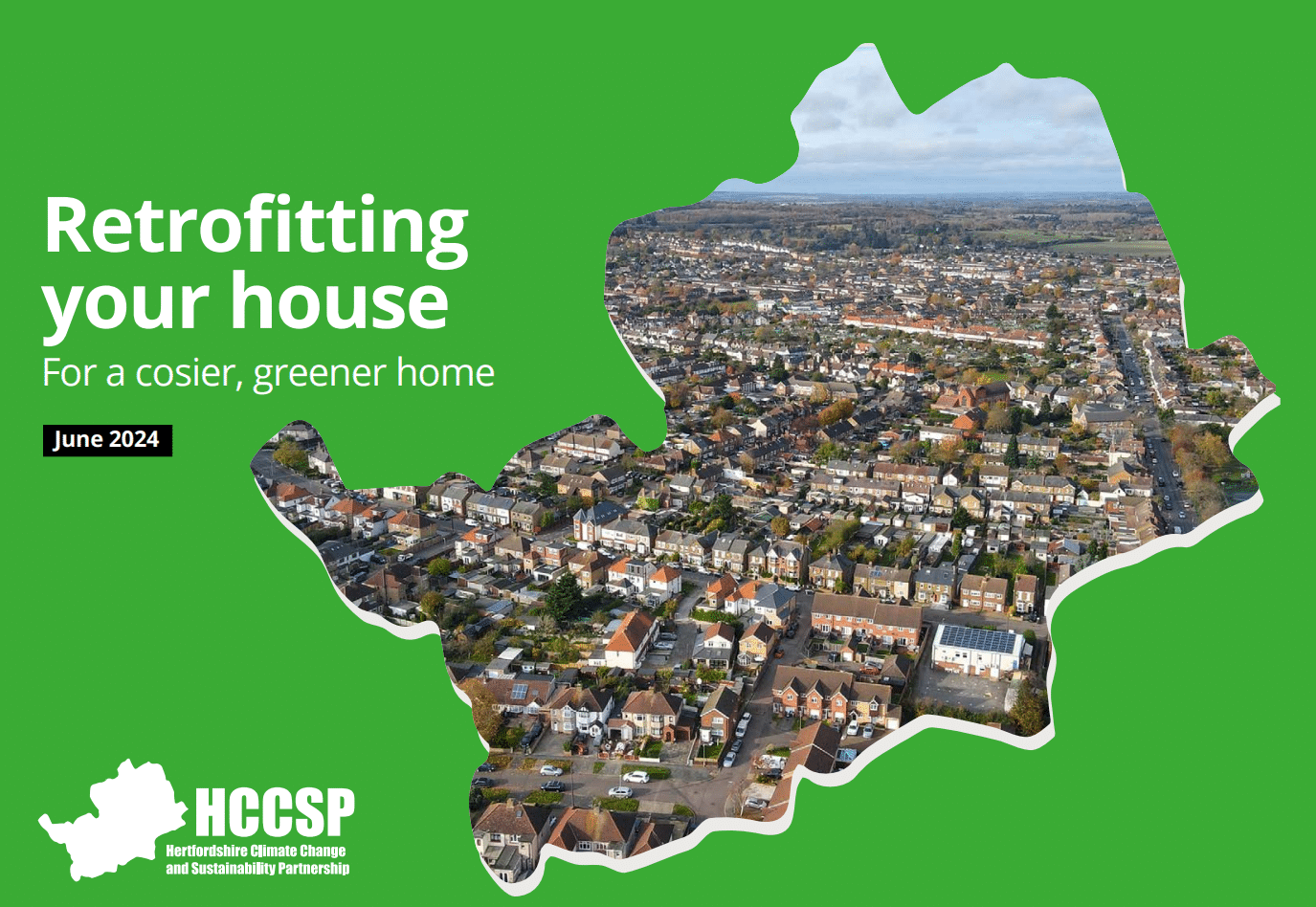
Hertfordshire Climate Change and Sustainability Partnership (HCCSP) has created a roadmap for homeowners seeking to embark on their retrofit journey including tailored advice for different property types.
PAS 2035 is an industry standard which seeks to avoid unintended consequences of retrofit and advises a Retrofit Assessment before carrying out works. Certain retrofit measures are not compatible with each other as documented in the BSI ‘measures interaction matrix‘. See below for more information on PAS 2035.
If you live in the district of St Albans you can borrow one of our thermal imaging cameras to see where heat is leaking from your house. See our Thermal Imaging Camera guide and this short guide to thermal bridging and click below to get in touch and use the thermal camera.
Image taken from outside the home showing heat leaking from single glazed panels at top. Also showing impact of a well fitted letter box cover
Reducing heat loss through doors and windows
Reducing heat losses from doors. Draught proof your door by fitting draught seals, prevent draughts through letter boxes by fitting a cover/brush and through keyholes by fitting a keyhole cover. If you have a catflap, you can fit insulation or a blanket flap.
Keep the heat where you want it. Close the doors on unused rooms to keep the heat where you need it.
Reducing heat loss from windows. Double or triple glazing will reduce heat loss considerably compared with single glazed windows. Less costly options are to cover them in a clear plastic film (available at DIY shops) that tightens over the pane when heated with a hairdryer. The image below (taken from the outside a home) shows heat leaking from single glazed glass in a front door; it also shows a letter box with a good letter box cover.
Curtains also reduce heat losses from windows. Close curtains and blinds at dusk, even in rooms you’re not using. If you have long curtains over a radiator, tuck the curtains behind the radiator (so as not to heat the window) or, better still, shorten the curtains! If your curtains are thin, sew a layer of heavy lining material inside them or buy some ready-made thermal curtain liners that hook on.
Gap sealer part fitted between floor boards
Reducing heat loss through walls and floors
Losses from radiators. Radiators on external walls can often direct the heat outside; consider putting foil behind radiators to reflect heat into the room; radiator foil is available from DIY stores, though kitchen foil does a good job too!
Losses through floorboards. If you have wooden floorboards (particularly those in older houses that are laid directly on beams), you can reduce heat loss by filling the gaps between and around them with an acrylic sealant or with tubing that you can put between the gaps. Timber floors can also be insulated by lifting the floorboards and laying mineral wool insulation supported by netting between the joists. Gaps between floor boards and skirting boards are also an area where heat can be lost; DIY stores have a variety of options for filling gaps. Using rugs or carpet also helps to reduce heat loss. In the image below shows floor boards that are laid directly onto beam. Significant draughts were coming through the floor boards; the image was taken part way through fitting gap sealer – it had been fitted in the lower part of the image but not the upper part.
Stop heat going up the chimney. Put a chimney balloon is any chimney that is not being used. Remember to take them out again should you decide to use your chimney.
Install or top up cavity wall insulation. If you have cavity wall insulation you can use a thermal imaging camera to check whether there are any areas missing insulation. In a house with cavity wall insulation, you would be able to see whether the insulation went around the whole house or whether the cavity was built room by room with bricks going directly from outside to inside at the room junctions. If the cavity wall did not go all the way round the outside of the house there would effectively be a cold bridge where the bricks were allowing heat to escape from your home.
Solid wall insulation. Solid walls can lose heat just like cavity walls; the only way to reduce this heat loss is to insulate them on the inside or (much better) on the outside. It’s not cheap, but you will soon see the benefits to your heating bill.
Thermal wallpaper. You can also put thermal wallpaper on the external walls in your home; this can be useful additional insulation or an alternative for homes with solid walls where solid wall insulation is not possible. This is something that can be done room by room as and when rooms are re-decorated.
Image shows the effect of an un-insulated loft hatch compared with the surrounding insulated roof.
Reducing heat loss through the roof
Insulate your loft. If you only have 100mm insulation topping this up to 300mm will cut your heat loss from the roof by 50%. If you only have 50mm you can reduce heat loss by 75% – source.
Check your loft-hatch. Have loft insulation but there are still draughts? Check to see if your loft-hatch has been insulated. You can also try to prevent those small drafts around your loft-hatch by using draught proofing tape. The image below shows a loft that has been insulated with an uninsulated loft hatch.
Get inspired by real world case studies
Two blogs about different aspects of a local retrofit:
It can be hard to find an insulation installer. Word of mouth is important, so it’s always worth asking around, including on Facebook groups like St Albans Eco and St Albans House Renovations.
Check out accredited professionals from websites like Trust Mark or Trusted Traders. Some jobs just require a handyman, but others – like external wall insulation – need a specialist installer.
You can walk through your home’s likely options with the tool Simple Energy Advice.
Use your appliances less, for example doing full loads of washing or dishwashing, using a clothes line to dry clothes.
Use LED lighting. Lighting accounts for 7 per cent of a typical household’s energy bill. Cutting your lighting bill is one of the easiest ways to save energy and money. Houses typically use a mixture of standard light fittings and downlighters or spotlight fittings. LED bulbs are now available for most fittings, replacing bulbs with LED ones will instantly save your home energy and money.
Controlling your heating. Boilers and heaters account for two-thirds of the energy used in our homes, so changing the settings just a little can have a big impact.
Lagging hot water tanks and water pipes. Many hot water tanks in our homes are not sufficiently lagged. This means that heat is continually being lost, and your boiler has to work harder to keep the stored water to the desired temperature. Heat is also lost from pipes that carry hot water around your house. In some places this is ok (e.g. through a cupboard that is used to dry laundry) but often, it’s just more unnecessary and expensive heat loss. Fitting a jacket on your hot water tank and insulating your hot water pipes will reduce your energy bills; there are a variety of insulation options for pipes available at DIY stores.
Be a real turn off! Leaving lights, TVs, computers and radios on when there’s no one in the room is an obvious waste of money and energy. Some appliances also use a lot of energy in standby mode, particularly if they are older appliances.
When replacing appliances look at the energy ratings. Appliances are responsible for a significant proportion of a typical home’s electricity bill: Televisions, set-top boxes, digital TV recorders, DVDs and DAB radios combined are responsible for around a fifth of a typical home’s electricity bill. Computer Equipment – household computers, printers, monitors and laptops on average make up around a further 13%. When you need to replace an appliance, you will have an opportunity to replace it with a more efficient one.
Further resources
Stay Warm for Less. A very readable booklet giving you lots of ideas step by step on what you can do to Stay Warm for Less
Energy Savings Trust. Their website provides information about saving energy.
Cambridge Carbon Footprintwebsite has useful resources relating to thermal imaging cameras and also more generally about reducing energy use.
Green our Herts website provides resources to help you make your home greener, as well as other information relating to reducing carbon use more generally.
St Albans District Council website also has useful advice including information about grants and measures to improve energy efficiency.
Check out the Great British Insulation Scheme here, and find out if you are eligible for free or cheaper insulation to reduce your home’s energy bills. You can also obtain additional information on the Money Saving Expert website.
Simple information on this and other grants and payments and energy saving measures can be found on the government Simple Energy Advice website.
List of local suppliers with thanks to AECOM St Albans’ volunteer, for creating this list of local suppliers who were those registered in 2020 to deliver insulation measures, and also suppliers of solar, heat humps and biomass boilers, under the Green Homes Grant in 2020.
*13. Home Upgrade Grant Phase 2 Further information
(HUG2) is a Government-funded local authority scheme for those properties that are off gas heating. The scheme aims to deliver energy-saving improvements to the homes of people who struggle to pay their heating bills and keep their homes warm in the winter. These improvements are made free of charge and will help residents to keep their homes warm while using less energy and help them to manage their heating bills.
If you own your own home, or are a tenant, or a private landlord with tenants, you could qualify to apply for energy-saving improvements.
The Home Upgrade Grant Phase 2 (HUG2) is open to home-owners and private tenants who meet all of the following criteria:
Homes not heated by mains gas which includes oil, coal, LPG or only electric heating. Households with a combined annual income of less than £36,000 OR receiving certain income-related means-tested benefits such as Universal Credit OR you live in an area of Index of Multiple Deprivation (IMD) income rated 1 to 3. Hard to heat homes with an Energy Performance Certificate (EPC) rating of between D to G. You will be helped with this part of the assessment and receive a free EPC assessment if you do not have one already.
The funding is provided by the Government and delivered by the Greater South East Net Zero Hub in partnership with St Albans Council and Warmworks.
To find out more information or to make an application please visit the website www.hugapply.co.uk or contact the Homes Upgrade Grant line on 0808 1968255