
Our Planet Our Future’s Book Club’s pick for November was Badvertising by Andrew Simms and Leo Murray. The book shines a light on the pervasiveness of high-carbon advertising and how it pollutes our minds and fuels the climate crisis. Drawing a parallel with tobacco advertising, which was outlawed at the start of the millennium, the authors argue for a similar ban for polluting advertising.
We started the session with an emotional check-in. One reader reported feeling cheated. They despaired that, with the state of advertising as it is, we’ll never save the planet. Another was shocked at the extent to which advertising invades our daily lives. But there was also hope that things are starting to change.
The main culprits: fossil fuels, SUVs and aviation
Sports sponsorship is a common way for highly polluting companies to build brand loyalty and deflect attention away from carbon-intense activities. But the book hammered home the huge disconnect between sports events — which often celebrate and depend on nature — and their high-carbon sponsors.
We discussed how advertising encourages us to overconsume. It creates a desire to fill our bodies with processed foods, damaging our health. It encourages us to jet off to faraway destinations every year. And it pushes the false belief that gas-guzzling SUVs are safer than smaller cars — despite being deadlier for pedestrians and drivers. SUVs have become so popular that Ford recently dropped production of its classic Fiesta model. Not because of a lack of demand, but because it was less profitable than SUVs.
SUV overconsumption is particularly relevant to St Albans because our air quality has been rated low. While EVs can go some way to reducing in-city emissions, there is still a way to go. Perhaps a weighty SUV tax would make drivers think twice before choosing one to help them do the school run and pick up shopping?
We vote with our wallet
Can advertising be used for good? There are companies promoting a responsible use of resources, and advertising is a good way for them to create brand awareness and scale their impact. Backmarket, which rehomes old devices, recently launched a global ad campaign to dispel the myth that ‘new is better’. Fairphone sells phones made from recycled and replaceable components.
And there are now ethical alternatives to everyday products on the market. One reader shared how she struggled to find natural cleaning products 10 years ago. Now it’s much easier (especially as we now have our very own refill service in Harpenden, courtesy of My Refill Life).
As social media platforms become less about socialising and more about turning users into ‘products’, new, ad-free alternatives have sprung up, including Mastodon and Friendica. We’re currently looking into setting up a Sustainable St Albans account on Friendica, so watch this space.
Could we ban high-carbon advertising in Harpenden?
The session took a lively turn when one reader, new to the district, asked about high-carbon advertising in Harpenden. In response, reader and Sustainable St Albans volunteer Martin pulled out the week’s Herts Advertiser, which had a four-page cover wrap advertising Jet2.
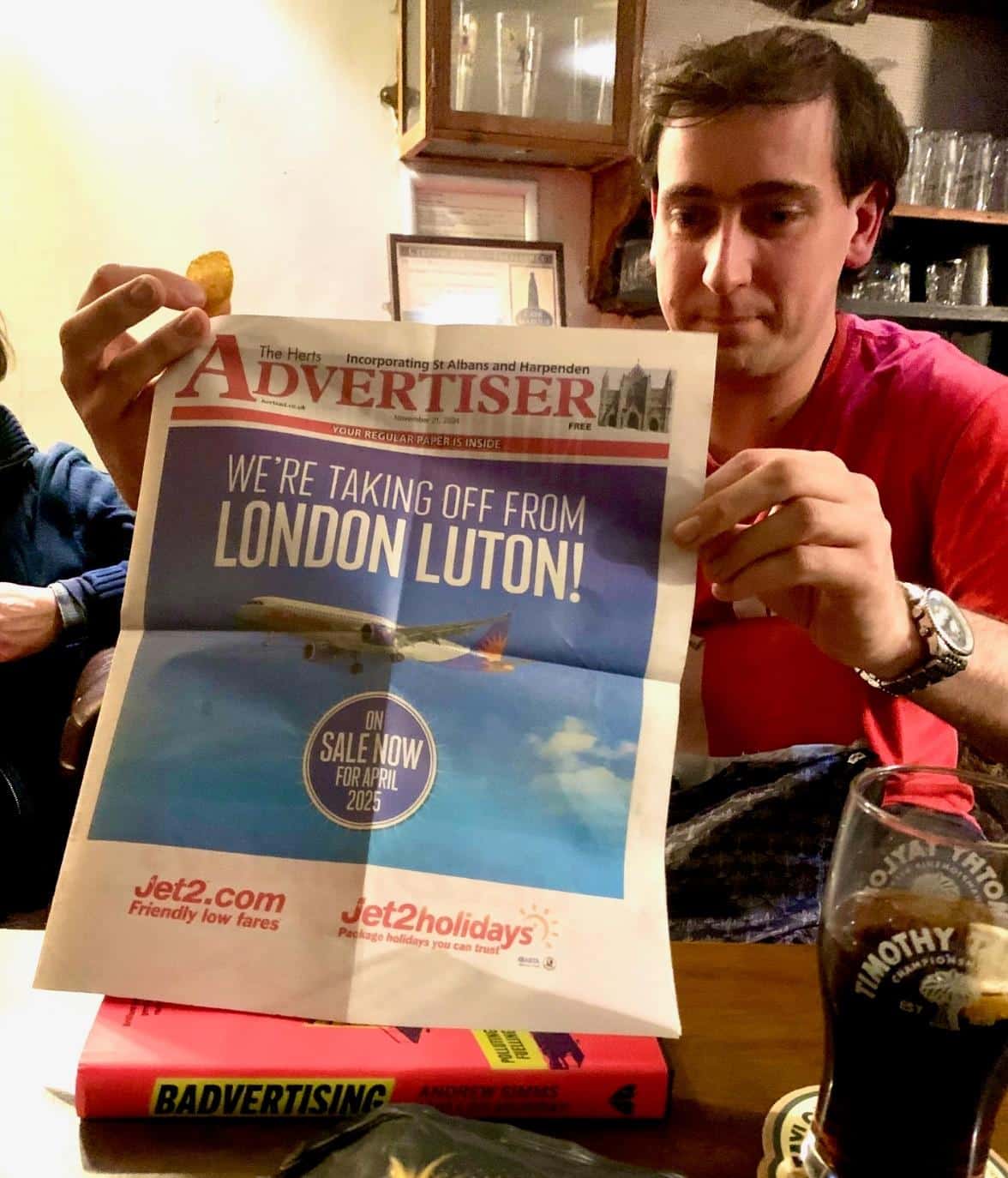
This was particularly concerning, given St Albans District Council has declared a climate emergency and has a target to meet net zero emissions by 2030. There are a few billboards around Harpenden, and we decided to keep an eye on the products that are being advertised.
But, as the book demonstrated towards the end, ad-free movements have sprung up with success, most notably in Bristol and Cambridge. So if we wanted to limit high-carbon advertising in St Albans, there is already a precedent.
The book’s authors, along with Adfree Cities, commissioned Richard Wald KC of 39 Essex Chambers to produce a legal opinion for local councils that want to restrict high-carbon advertising. The review concluded that, despite a lack of national definition of ‘high carbon’, a ban would be lawful and there would be minimal legal risks. You can read the opinion in full here.
Find out more about Badvertising here.
Take action on advertising
Inspired to challenge the advertising around you? Here are some ways you can get involved:
- Explore ad-free social networks such as Mastodon and Friendica. You can find a full list of open-source networks (known as the fediverse) here. If you get on with one of the platforms, spread the word!
- If you see a high-carbon billboard in the St Albans district, you could contact your local councillor and point out that high carbon advertisements contradict the district’s net zero targets.
2024, a year of inspiring environmental reads
The Our Planet Our Future Book Club has enjoyed five lively, well-attended sessions this year. In January we began the year reimagining what is possible with From What Is To What If by Rob Hopkins. In April we explored how to avoid runaway climate change with Simon Sharpe’s Five Time Faster. George Monbiot’s examination of our food systems in Regenesis was the subject of June’s read. And Kate Raworth’s Donut Economics prompted us to take another look at growth.
An Environment book club has also recently launched in St Albans.
Our next events
We’re looking forward to diving into more sustainable reads in 2025. We’ve already picked the next three books and set the dates for the next Book Club meets:
- Thursday 27th February – Blue Machine by Helen Czerski. Available at Hertfordshire Libraries, Audible, Borrow Box and in hard copy.
- Thursday 24th April – Braiding Sweetgrass by Robin Wall Kimmerer. Available at Hertfordshire Libraries, Audible, Borrow Box and in hard copy.
- Thursday 26th June – Prosperity Without Growth by Tim Jackson. Available on Audible and in hard copy.
- Thursday 23rd October – tbc
- Thursday 4th December – tbc
All sessions take place at the Cross Keys pub in Harpenden. Book your free spot here.
About Our Planet Our Future’s Environment Book Club
Our Planet Our Future, our landmark series of talks and events, launched an Environment Book Club in 2023, meeting in Harpenden to discuss sustainability-related reads.
Love this! A very interesting read. Specially the views shared re SUVs’ advertising made me think about the importance of accelerating the use of EVs. This is an interesting website with a lot of information including charging points for EVs. https://www.zap-map.com/